Two Autographs: Heath Robinson of Infinite Black on his photo in the GenCon program, and Cherie Priest, Author Guest of Honor on her book "Four and Twenty Blackbirds".
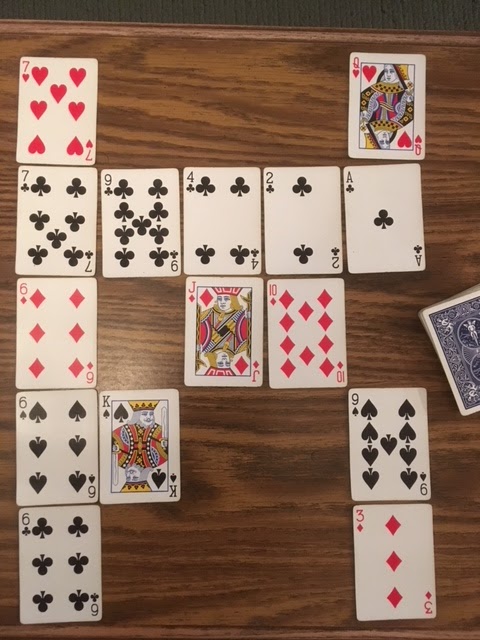
Worst Time to Host a Game: Thursday morning. Hundreds, maybe thousands of con goers were still in the Will Call line, not a lot of gamers in the playing hall. I had no one for my 11:00 am session of Throw Down Seven.
Good Hosting: Four folks came and played Throw Down Seven on Friday afternoon at three. They were dice lovers, so were perfect for this. They had each bought a set of dice in the exhibit hall and used their own to play. They emailed me later to say they had played again at dinner.
In the Booth: Throw Down Seven from ChipsterzoneGames was for sale in the Indie Game Alliance booth.
In the Booth: Throw Down Seven from ChipsterzoneGames was for sale in the Indie Game Alliance booth.
Pricey but Convenient: The Holiday Inn Express was quite nice, with a full hot breakfast and is far from the most expensive hotel within a couple blocks of the Convention Center, but at over $200 a night, it's still much more than I'm comfortable paying for a hotel room. They handled the crowd well.
Overwhelming: The exhibit hall was huge and packed with people the entire time. Nice to be with the bustle, but would have been nice to have more elbow room.
Top Technical Innovation: Dice, physical dice, that know what they roll, and tell your software. These are way cool, though still under development: https://www.electronic-dice.com/
Gorgeous Game: "Parks" designed by Henry Audubon and will be published by Keymaster Games in October.
Sold Out! But I played them: "Klask" is a bit like miniature knock-hockey with magnet-limited sticks. And "Point Salad" is a card drafting game with vegetables on the cards. Odd, but kind of fun.
Schlock Mercenary, Weird Giraffes, and Infinite Black in the exhibit hall: Pleased to talk shop briefly with Howard Tayler in his booth and said "hey" to fellow Alabama game producers in a couple other booths.
Only Three: seminars I attended this time. The writing track was still big, but I recognized fewer of the authors. I only went to a Revisions panel there, other talks were from Panda Games and on Script Writing (in the film track).
Script Writing: Thomas DeCarlo, from Bloomington (where we spent Wednesday night pre-con, about an hour out from Indy), he does animation; Kylie Eaton, "Dispel", Writer/Director; May (somebody), Australian comedienne/actress/writer; Timothy Tray, ABBY; Dan McGuire, ABBY
Writing is solitary, directing is social.
Fit your script to time/budget: 3 locations, 2 speaking parts, 4 days to shoot -- if really going to film it
Script Notes Podcast #403 recommended (w Craig Mazin and John August)
Recommended books: Screen Play by Syd Field and Save the Cat by Blake Snyder.
Hook in the first couple pages
Write for visualization (setting or character come first)
E.g. describe a person sitting quietly reading, then describe the chaos around them
Use cards, one scene per card, can rearrange them easily
"If you watch a movie w/no sound you should get 80% of it" - Alfred Hitchcock
Outline in Word, or Final Draft
Know what you're writing for: spec? Go big! short film to shoot with friends, or for demo? time/budget/locale
Accept that a script is a living document, will be interpreted, re-written, etc.
Only write what can be seen and heard -- tough to script smell, touch
Don't give direction, but help the cast/crew: "sitting alone weeping in a bathtub" and not "he felt sad"
Game Manufacturing presented by Panda Games.
Online quote system -- get an idea of costs, even if you don't go with them as manufacturer
Can Kickstart, or not.
50% of per game cost + 100% of tooling costs up front
Good to know things like what needs to maintain hidden info, e.g. matching card backs
Cards per sheet (so target that number): 54 black jack size, 62 Taro size
Chinese holidays will impact schedule
Put a blurb on the quote to indicate intent of game, gives the project some context
PPC article is a hand crafted one off (Prototype Proof of Concept?)
MPC is first game off production
Suggestion: work with an experienced graphic designer (and fulfillment partner)
Adult Hobby Market: 14+ age designation avoids some safety testing
Panda shipping is extra, does not do fulfillment
Tariff issues are unknown.
1500 game minimum, 2500-5000 is more the sweet spot.
Panda Prepping for Printing
contact@pandagm.com
Suggest to use a graphic designer or layout specialist with experience in print media
Need your own UPC # (resale ones are fine for hobby market)
Black text should be pure black
Panda has templates on their website
Use Preflight Profile in Acrobat
(I really liked the folks from Panda, they were down to earth and clearly enjoy their work of bringing new games into the world.)
Revisions Panel, Writing Seminar
John Helfers, Editor; Howard Andrew Jones, Author; Cerece Rennie Murphy, Author
Finish the first draft!
Cerece kind of stole the show, an attractive 30-something African American, she introduced herself as a children's author, then proceeded to drop sporadic F-bombs.
Check the distance between what you wrote and what you thought you wrote
Read it out loud. Try read aloud mode from MS Word. (I tried letting Word read some, not bad.)
Read it out of order. Maybe one character's POV at a time, or last section of a chapter and back by sections.
Know what each character needs from each scene, what their emotional state is.
Does the plot work?
Make sure if your character goes after some big magical item that it gets used (Ahem, HBO Game of Thrones)
Everything should serve a point (to keep readers turning pages) -- advance plot; advance character.
Good to use others to review: developmental editor, copy editor, proof reader.
Dr. McCoy Test: "I'm a doctor, not a bricklayer."
Recommended: Steve Pressfield "The War of Art"
Also: Save the Cat, same as from the Script Writing Panel
Too Big?: Once again I enjoyed GenCon, but since I wasn't focused on the sideshow that is the writing seminar I was more immersed in the larger show and it was a bit overwhelming. And crowded. But getting to play hot, pre-release games, and talk to a lot of friendly people, both ones trying to sell me something and those just doing what they love, is a good time.
Game Manufacturing presented by Panda Games.
Online quote system -- get an idea of costs, even if you don't go with them as manufacturer
Can Kickstart, or not.
50% of per game cost + 100% of tooling costs up front
Good to know things like what needs to maintain hidden info, e.g. matching card backs
Cards per sheet (so target that number): 54 black jack size, 62 Taro size
Chinese holidays will impact schedule
Put a blurb on the quote to indicate intent of game, gives the project some context
PPC article is a hand crafted one off (Prototype Proof of Concept?)
MPC is first game off production
Suggestion: work with an experienced graphic designer (and fulfillment partner)
Adult Hobby Market: 14+ age designation avoids some safety testing
Panda shipping is extra, does not do fulfillment
Tariff issues are unknown.
1500 game minimum, 2500-5000 is more the sweet spot.
Panda Prepping for Printing
contact@pandagm.com
Suggest to use a graphic designer or layout specialist with experience in print media
Need your own UPC # (resale ones are fine for hobby market)
Black text should be pure black
Panda has templates on their website
Use Preflight Profile in Acrobat
(I really liked the folks from Panda, they were down to earth and clearly enjoy their work of bringing new games into the world.)
Revisions Panel, Writing Seminar
John Helfers, Editor; Howard Andrew Jones, Author; Cerece Rennie Murphy, Author
Finish the first draft!
Cerece kind of stole the show, an attractive 30-something African American, she introduced herself as a children's author, then proceeded to drop sporadic F-bombs.
Check the distance between what you wrote and what you thought you wrote
Read it out loud. Try read aloud mode from MS Word. (I tried letting Word read some, not bad.)
Read it out of order. Maybe one character's POV at a time, or last section of a chapter and back by sections.
Know what each character needs from each scene, what their emotional state is.
Does the plot work?
Make sure if your character goes after some big magical item that it gets used (Ahem, HBO Game of Thrones)
Everything should serve a point (to keep readers turning pages) -- advance plot; advance character.
Good to use others to review: developmental editor, copy editor, proof reader.
Dr. McCoy Test: "I'm a doctor, not a bricklayer."
Recommended: Steve Pressfield "The War of Art"
Also: Save the Cat, same as from the Script Writing Panel
Too Big?: Once again I enjoyed GenCon, but since I wasn't focused on the sideshow that is the writing seminar I was more immersed in the larger show and it was a bit overwhelming. And crowded. But getting to play hot, pre-release games, and talk to a lot of friendly people, both ones trying to sell me something and those just doing what they love, is a good time.