Showing posts with label Solitaire. Show all posts

Tuesday, February 27, 2018

Games without Dice

There's another sort of game that I like to play, one that doesn't involve dice, but where objects are also rolled on a table often covered with green felt: pool, or billiards so as not to be confused with lounging in and around a concrete depression filled with chlorinated water. That can be fun, too, but I'm referring here, in the context of Chipsterzone Games, to parlor pastimes.

I've played a fair bit of 8-ball, and also of Cut-throat over the years. Much of my 8-ball was played a good while back, during college breaks at bars on coin-operated pool tables. I was never particularly good, but perhaps understandably I got a wee better after one drink, let me get out of my head so much, I suppose. My friend, let's call him Tim (since that is his name), got worse at pool with the first drink, but better at Space Invaders, the video game. I got only worse at video games with alcohol. Ah, comraderic competition!

But even at its best my 8-ball wasn't very good. When we moved to Raleigh, NC during high school however the house my parents bought came with a full-size, heavy slate pool table in the basement. My father soon introduced me to an entirely different sort of pool game that they played at the Marine Corps Reserve Center on their lunch breaks (and I'm guessing any other time that things got slow).

They called it simply "Pocket Billiards" and the main object, rather than to shoot balls into the pockets as in most games played on a pool table, was to make "billiards" to score points. That is, players try to make a stroke in which the cue ball strikes two other balls. This is wonderfully difficult, especially at first. It becomes somewhat less difficult as the player understands how, and when, to put various kinds of English, or spin, on the cue ball. Of course English is important in 8-ball or any other game on a pool table, but it's critical in shooting billiards to control where the cue ball goes after contact with another ball, or the rail, and to avoid letting the cue drop into a pocket and scratching a batch of points.

I played a bunch of this game on my dad's table through the rest of high school and college, both alone and with family and friends, but then played it very little for a couple of decades. I've recently resurrected it at my own place of work where we have a pool table in the parlor games area adjacent to our cafeteria. Other games there include table tennis and Foosball. As I introduced it to some of my colleagues there was some confusion over the name and to prevent it being known simply as "Chip's Game", a title I hadn't earned since it's not my invention in the least, I dubbed it Billiards 321 (for reasons that the rules, below, will make obvious).

I recommend it highly for anyone who enjoys playing on a billiards table, but not so much the standard sinking of balls. My chief rival at Billiards 321 here at work has begun this year by creating a spreadsheet to track our competition. He's broken it down into weekly and monthly increments, determined to best me at some interval. His specialty is making "pots" (sinking balls into the pockets), while mine is making the billiards, so we choose differing shots from similar positions and it keeps things lively.

Without further ado, the rules:

Billiards 321


Billiard: hitting two balls with the cue ball during one shot; English (spin) can make all the difference!

Break: 
A) Set up the 3, 2 and 1 balls in their home positions as shown: 3 and 1 on the spots, 2 ball in center
B) Cue ball to one side or the other of the 1 ball, no more than a ball's width away.
C) Cue ball must hit 2 rails, including the far rail, before touching any balls, then must hit 2 balls (make a billiard) to be a good break.
D) Players take turns attempting to break until either someone makes a billiard or each player has made an attempt.
E) If the last player fails to make a good break then the first player begins regular play where the balls ended.

Play: 
A) Must make a billiard to open a turn.
B) Subsequent shots can either sink a ball or make a billiard to continue a turn.
C) Sunk balls are returned to their home position for the next shot (or as close as possible without touching any other balls)
D) If a player scratches during a turn all points accumulated on that turn are lost (A scratch in this game is when the cue ball goes into a pocket, or off the table, or the shooter fouls by hitting other balls than the cue ball with stick, hand, etc.)
E) After a scratch the next player must start from within a ball's width away from the one ball's home position and must hit the far rail prior to touching any other ball.

Scoring: 
A) A billiard is 2 points (hitting all 3 balls in one shot is 5 points)
B) Sinking a ball scores the number of points on the ball: 3 ball is 3 points, 2 ball is 2 points, 1 ball is 1 point
C) Both billiards and ball points can be scored in the same shot
     a. It is not required that the billiard completes before the ball falls in the pocket
     b. Example: a player hits both the 1 ball and 3 ball with the cue and pots both balls; that is  2 + 1 + 3 = 6 points for that shot.
D) Players accumulate their points verbally during a turn and then record them at the end of their turn, this way only unscratched points are retained.

E) A standard game is to 50 points, it is not required to hit 50 exactly


 Advanced: This is a billiards game, if some players tend to score too many points by shooting balls then the “billiards rule” can be added, either at the beginning of a game, or during a game if so agreed prior to start. From the point the rule is put in place no more than 2 ball shots in a row without billiards are allowed. If a player shoots 3 ball-only shots then they can keep all points but their turn ends. The sunk ball(s) are re-tabled and the next player shoots as after a miss. (The other players should verbally note when 2 ball shots have been completed without a billiard so everyone is aware that the next shot must include a billiard for the turn to continue.) 

Higher Scoring Variant: When a ball is sunk replace it with the next lowest ball that hasn’t been in play, always spot it on the farthest open home spot from the cue ball (if equidistant then farthest from the other balls). Balls continue to score their face value, wrap back to the lowest ball after the 15 has been used (e.g. back to the 1 ball). Billiards score 5, hitting all 3 balls scores 8. Play to a higher number, e.g. 200.


Have fun !!


Saturday, December 30, 2017

Poker Solitaire Rubric

I've mentioned Poker Solitaire, the card game, to a few people lately (mostly when introducing them to my new polyhedral dice solitaire game, Throw Down Seven), but apparently not everyone is familiar with Poker Solitaire so I thought I'd give a run-down of it, the way I like to play.

Background

Also known as Poker SquaresPoker Solitaire is a simple but challenging game with a nice mix of strategy and chance. I learned it from a book on card games, maybe one of the Hoyle books, decades ago. It's not as simple (and mindless) as Clock (click through for someone else's YouTube video that will give you an idea of the version of Clock that I grew up with), but it also has a nice tactile feel like Clock does. This is one reason I prefer to play it with real cards though there are many online and app versions available. The other reason is that none of the digital versions that I've found use my preferred scoring rubric. (I admit we adjusted the one from the original book slightly for more appropriate scoring, e.g. at only 2 points, pairs, were almost meaningless, but I get ahead of myself....)

Poker Solitaire can be played as a win/lose (binary outcome) game, like Clock, or it can be played for score. In Poker Solitaire you try for high score, unlike in Throw Down Seven where lower scores are better. Win/lose Poker Solitaire was featured in the old western TV series Maverick, from the late 1950's and early 1960's. It was in one of the episodes with James Garner, but I don't know which one. (Please let me know if you do!) I'm not sure if they played it as Jacks or Better, or some other level. I find it harder to win at that level than Clock, which you should win about 1 out of 13 tries. I'll sometimes play the win/lose version if I'm only playing one or two rounds, but generally I prefer to play five rounds at a time.  

So How Do You Play?

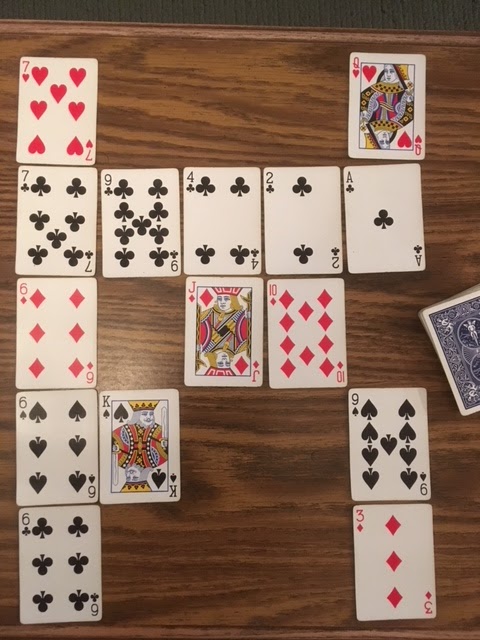
Simple, if you know your poker hands. Take a standard deck of  52 cards, shuffle it. Then draw cards from the top of the deck one at a time, placing them in (an imaginary) 5 x 5 grid. Once placed a card cannot be moved. (Apparently some people allow the location of the 5 x 5 grid to shift, but I call that cheating.) Like this:

Poker Solitaire (hand in progress)

You build 10 poker hands simultaneously, 5 horizontally and 5 vertically. In the picture above you can see that the second row has a flush and the first column has a full house. I'm building toward flushes in three of the other rows and hoping for two pairs, three of a kind, etc. in the other columns. (There's a long shot of a straight in the second column, and the best I can do in the fifth column is a pair at this point. The bottom row is usually trash, though you never know.)

What about Scoring?

As I said above, I like to play 5 rounds with a goal of scoring a total of 1,000 points, or an average of 200 points per round. That's a challenging mark. Here's the scoring rubric:

Hand            Points
Pair                  3 
2 Pair             10
3 Kind            20
Straight          25
Flush             25
Full House     40
4 Kind            60
St. Flush        75
Royal Flush  100

(Didn't get at least a pair in a hand? That's zero points, sorry.)

A perfect round is 775 points (4 Royal Flushes and a Straight Flush, with the 4 of a Kinds all lined up in columns but in practice rounds over 300 are very rare while it's easy to botch a round and score under 100.)

I haven't found an app or online version that let's me set the scoring system, but if you know of one I'd like to see it!

This is a good version for two players who don't want to compete against each other, you can alternate who plays a round and try to get to 500 together. The second time the other person will get to play three rounds.

Win or Lose Version

If you don't want to keep score you can try to get a certain level of hand, or better. I usually play this as Jacks or Better, but laying out 10 hands with at least a pair of Jacks or better is tough (for me, at least). No junk row! It's much easier if you play it as Ace High or Better, or Any Pair or Better.

Have fun!