Showing posts with label Dice Games. Show all posts

Saturday, December 30, 2017

Poker Solitaire Rubric

I've mentioned Poker Solitaire, the card game, to a few people lately (mostly when introducing them to my new polyhedral dice solitaire game, Throw Down Seven), but apparently not everyone is familiar with Poker Solitaire so I thought I'd give a run-down of it, the way I like to play.

Background

Also known as Poker Squares, Poker Solitaire is a simple but challenging game with a nice mix of strategy and chance. I learned it from a book on card games, maybe one of the Hoyle books, decades ago. It's not as simple (and mindless) as Clock (click through for someone else's YouTube video that will give you an idea of the version of Clock that I grew up with), but it also has a nice tactile feel like Clock does. This is one reason I prefer to play it with real cards though there are many online and app versions available. The other reason is that none of the digital versions that I've found use my preferred scoring rubric. (I admit we adjusted the one from the original book slightly for more appropriate scoring, e.g. at only 2 points, pairs, were almost meaningless, but I get ahead of myself....)

Poker Solitaire can be played as a win/lose (binary outcome) game, like Clock, or it can be played for score. In Poker Solitaire you try for high score, unlike in Throw Down Seven where lower scores are better. Win/lose Poker Solitaire was featured in the old western TV series Maverick, from the late 1950's and early 1960's. It was in one of the episodes with James Garner, but I don't know which one. (Please let me know if you do!) I'm not sure if they played it as Jacks or Better, or some other level. I find it harder to win at that level than Clock, which you should win about 1 out of 13 tries. I'll sometimes play the win/lose version if I'm only playing one or two rounds, but generally I prefer to play five rounds at a time.  

So How Do You Play?

Simple, if you know your poker hands. Take a standard deck of  52 cards, shuffle it. Then draw cards from the top of the deck one at a time, placing them in (an imaginary) 5 x 5 grid. Once placed a card cannot be moved. (Apparently some people allow the location of the 5 x 5 grid to shift, but I call that cheating.) Like this:
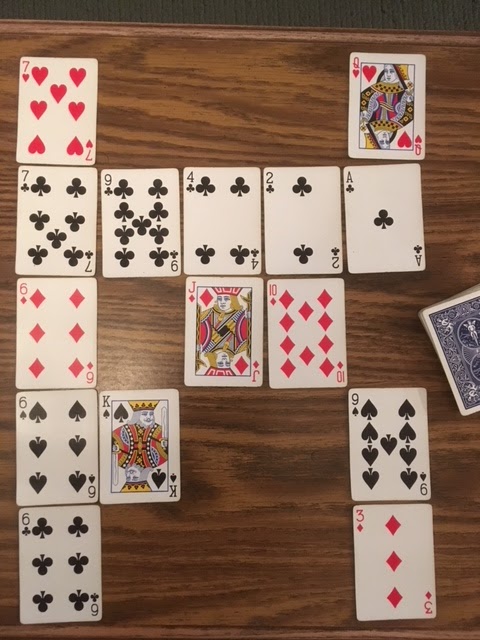
Poker Solitaire (hand in progress)

You build 10 poker hands simultaneously, 5 horizontally and 5 vertically. In the picture above you can see that the second row has a flush and the first column has a full house. I'm building toward flushes in three of the other rows and hoping for two pairs, three of a kind, etc. in the other columns. (There's a long shot of a straight in the second column, and the best I can do in the fifth column is a pair at this point. The bottom row is usually trash, though you never know.)

What about Scoring?

As I said above, I like to play 5 rounds with a goal of scoring a total of 1,000 points, or an average of 200 points per round. That's a challenging mark. Here's the scoring rubric:

Hand            Points
Pair                  3 
2 Pair             10
3 Kind            20
Straight          25
Flush             25
Full House     40
4 Kind            60
St. Flush        75
Royal Flush  100

(Didn't get at least a pair in a hand? That's zero points, sorry.)

A perfect round is 775 points (4 Royal Flushes and a Straight Flush, with the 4 of a Kinds all lined up in columns but in practice rounds over 300 are very rare while it's easy to botch a round and score under 100.)

I haven't found an app or online version that let's me set the scoring system, but if you know of one I'd like to see it!

This is a good version for two players who don't want to compete against each other, you can alternate who plays a round and try to get to 500 together. The second time the other person will get to play three rounds.

Win or Lose Version

If you don't want to keep score you can try to get a certain level of hand, or better. I usually play this as Jacks or Better, but laying out 10 hands with at least a pair of Jacks or better is tough (for me, at least). No junk row! It's much easier if you play it as Ace High or Better, or Any Pair or Better.

Have fun!

Saturday, August 26, 2017

GenCon The Second

Beginnings

I like dice. I'm not a gamer -- not a larping, cosplaying, role-embracing, miniature painting, up-all-night D&D-er. But I do like dice. I'm designing a polyhedral dice solitaire game. Maybe two. And I like board games. And I wanted another chance to discover new games and to hang out with writerly folks and friends from Writing Excuses and to hear wise instruction and tales from living-making authors. So I traveled to GenCon again this year.

It was bigger than ever. Mostly that meant more crowded, even though they spread things out more, too, more, that is, than the other time I attended, which was 2015. But I'm getting ahead of myself. First there was The Journey, a leisurely six hour drive to Indianapolis with a stop in Louisville for some Skyline Chili. I listened to a small portion of The Wise Man's Fear by Patrick Rothfuss. It's 36 CDs long, so when I say a small portion I mean about a twelfth.

It turned out I drove a little too leisurely, forgetting that Indianapolis, despite being almost due north of Huntsville, is eastern time; so instead of checking in to my hotel first I went straight to the Indianapolis Table Tennis Club. I played a good couple of hours there and then headed back to the other side of town and my La Quinta home for the next 4 nights.

Like all the area hotels it was sold out largely with GenCon attendees. I smiled to see the lobby full of gamers gaming. Even the desk clerk had done her hair blue for the occasion. It was late and I went straight to bed after showering and eating and channel surfing for a couple of hours.

On to the Show

I really wish my first Writer's Symposium panel had been truer to its title: Writing 101: The Basics -- From POV to Punctuation. At one point Kelly Swails (moderator) started to dive into something, maybe dialogue attribution and when you could skip including "she said" and the like but quickly stopped herself saying that was more like Writing 201. Exhale. We did get some story and self-motivation basics:

Persistence, Time, Discipline. Know what the characters want. Know what the villains are planning to do. (Eric Scott DeBie)

First Draft: What you want to say (Heart). Final Draft: How you want to say it (Head)(Howard Andrew Jones).

Starting reluctance means the scene isn't right (work your outline?) Read. Look at grammar and sentence structure in what you read. Butt in chair. "I won't screw this scene up if I don't write it." Allow yourself to write a bad story. (Swails)

Time management. Write for yourself first. (Dan Wells)

Panel Two: Real Monsters and Vicious Animals (Elizabeth Vaughn, Larry Corriea, Christopher Husberg, Eric Scott De Bie)

Do description through POV reaction.
Use other senses (than sight).
Contrast the mundane with monsters.
More on YouTube than most of us can stand. Shaved bear. Cryptozoology. Wikipedia.
Perception gets blurry in a fight -- go a little bit random and sparing.
Action scenes can be wordy and okay but really wordy can confuse a reader. Movies have the luxury of dragging a viewer forward to the next scene, words on a page can't.

Quick Trip to the Convention Floor

After two panels I had a break and hit the exhibit hall. It is huge. Hundreds of vendors and thousands of people. I found Howard Tayler's booth and chatted with him briefly while he drew. I bought the well-worn version of the Schlock Mercenary Maxims book. Howard signed it for me. Then I found Brandon Sanderson and Dan Wells' booth and bought some of Dan's audio books. Later I had him sign them for me.

Next I went to the Calliope Games booth. I had backed a Kickstarter for a new game called Dicey Peaks. The game wasn't expected until October but had come in early and they had arranged pick up and demo games at GenCon, which was sweet. I picked up my signed copy and later got to play a round with the game's designer, Scott Almes. I did not win. But I did get to ask him whether there was a way to play it as solitaire. He said there was no official variant in the rules but that you could play and try to minimize the number of turns it takes to plant your flag atop the mountain. Did I mention I'm designing my own solitaire dice game? Cool to get to talk on the subject with an accomplished designer.

More Panels

Worldbuilding: Creating a Universe of Worlds (Susan J. Morris, Brandon Sanderson, James Sutter, Dave Mack, Marco Palmieri)

I was here, like dozens of others, to get a dose of Brandon Sanderson, but as usual everyone was terrific. In particular Susan J. Morris is a great moderator. Marco is also an editor so brings that perspective.

How to avoid info dumps? Have a newbie/fish-out-of-water character that has to have other characters explain stuff to them. or just bring stuff in gradually, sci-fi/fantasy readers don't need everything clear from the get-go.

Brandon: A grand skill is to be informative AND entertaining.

Avoid tokenism, consider having more than one character from a culture and show differences and similarities.

James Sutter is with Paizo who's new science fantasy role playing game, Starfinder, dropped on Thursday. Their booths had hundreds of people in line all day to pick up copies.

Writer's Craft: Are You Overthinking the Story (Kelly McCullough, Richard Lee Byers, Beth Cato, ??)

Stay in writer brain for first draft, keep editor brain at bay.

World building iceberg -- only a seventh may end up visible in the story but the rest needs to be there, but not fully formed. How much? Who knows...

Stuck on a scene? Look at it from another (tertiary) character's point of view.

I'm interested to check out Beth Cato's Breath of Earth.

Not To Be Missed

An Evening with Patrick Rothfuss

He sold out the large ballroom, so 1,000 or more seats and it filled. Once again he had us agree to not share the grittier details of his regalations, but if you get the chance, he is funny and real. A good storyteller. He's a relatively new parent and has found new connections with parents, the way he had with geeks before that -- just another tribe.

He also asserted, strongly, something that I had already settled on in my mind: in stories, you don't have to kill people for drama. There doesn't have to be horrible death to make a story compelling. You need tension, and stakes, but it doesn't have to be gruesome and final. Especially not for works targeted for all ages. He had some psychology to back up why it might not be good.

He also had some psych on why "spoiling" very young children is a good thing. The young brain decides what kind of world it lives in: nurturing and safe or cutthroat and dangerous. It gets ingrained and manifests in "do unto others". (My words, but I think I got the meaning.)

Late Dinner

Me and some of my fellow Writing Excuses Retreat alumni met Dan Wells for dinner about 10:00 pm at the Ram restaurant. They had reprinted their menus just for GenCon (this con is a big deal for downtown Indianapolis). I had the occasionally named "Fry Haddock and Release the Dogs of War". It was delicious. They had also swapped the in-house TVs from their normal sports fare to showing Bladerunner. It had been a long day and dinner was cozy but sedate.

It was followed by my 15 minute drive to La Quinta and a much shorter session of channel surfing.